
 |
By: Dr. Kimberly Huynh D.C. |
|
October 29th, 2026 · 4 min |
When you visit a chiropractor, they may assess more than just your spine. A postural and functional assessment
looks at your body's alignment, movement patterns, range of motion, muscle strength, and overall function.
Your chiropractor may observe how you stand, move, and balance to identify patterns that may be relevant to
your symptoms or movement limitations.
In this blog, we'll explore what your chiropractor looks for during a postural and functional assessment, the
tests they may perform, and how these findings help guide a personalized approach to your care.
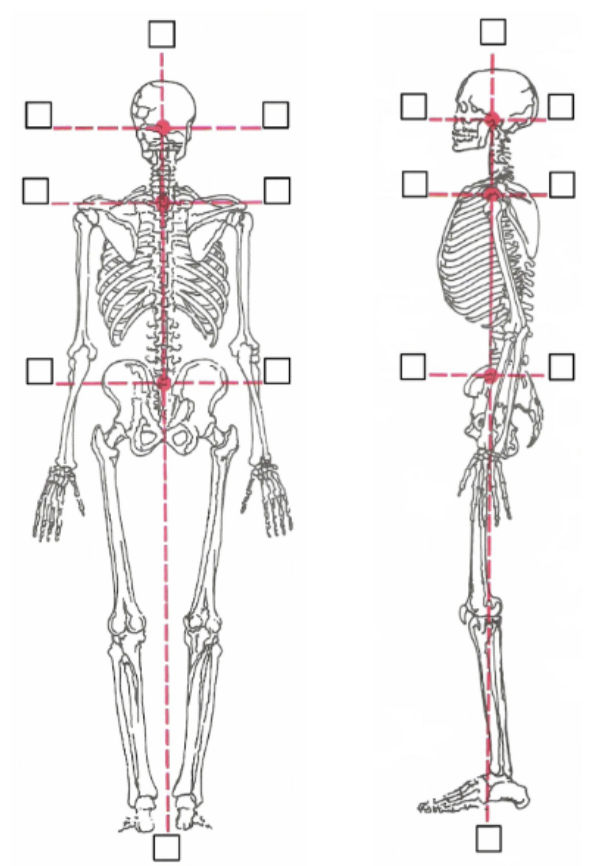
A postural assessment typically begins with a head-to-toe observation of your body. Your chiropractor may
assess the alignment and positioning of your cervical (neck), thoracic (upper and middle back), and lumbar
(lower back) regions, along with your pelvis and lower extremities.
Depending on your concerns, your chiropractor may observe your posture from the front, back, and side to
identify patterns in alignment, muscle activity, and symmetry.
Remember, there is no single perfect posture. Everyone has natural differences in their anatomy, mobility, and
movement patterns. Rather than simply looking for deviations from an ideal position, your chiropractor
considers your posture alongside your symptoms, functional abilities, and health history.
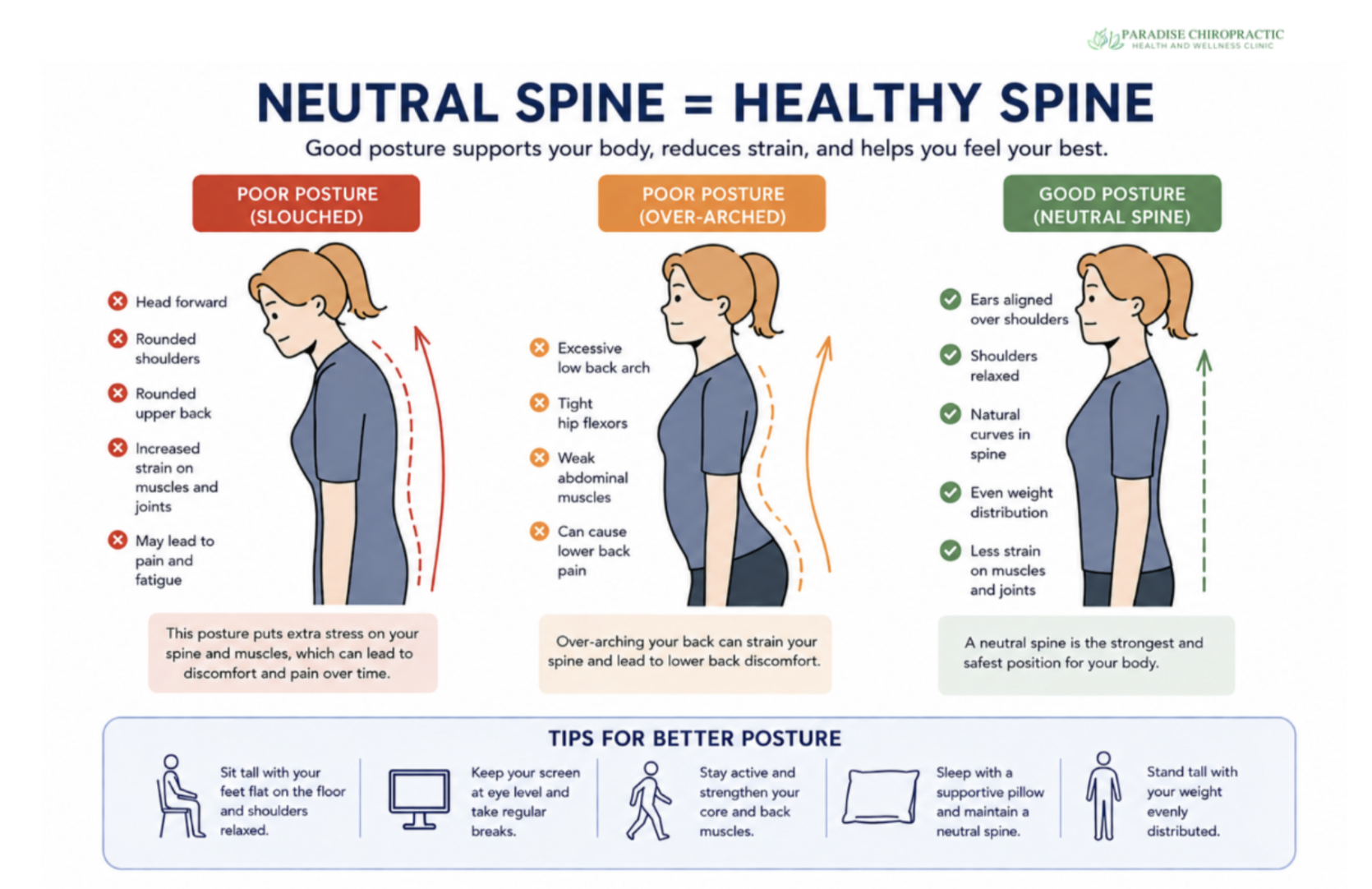
1. Cervicothoracic Region (Neck and Upper Back)
Your chiropractor may assess the following:

☐ Forward head posture
☐ Cervical lordosis: The natural inward curve of the neck.
☐ Thoracic kyphosis: The natural outward curve of the upper and middle back.
☐ Elevated shoulders: One or both shoulders appear higher than the other.
☐ Internally rotated shoulders: The shoulders rest in a position of internal rotation, which may contribute to a
rounded-shoulder appearance.
☐ Rounded shoulders and scapular protraction: The shoulder blades sit farther forward and around the rib cage.
☐ Scapular winging: Part of the shoulder blade, often its inner border, becomes more prominent away from the rib
cage.
☐ Sternoclavicular and acromioclavicular symmetry: The positioning and symmetry of the joints connecting the
collarbone to the breastbone and shoulder blade.
☐ Muscle tone and tension: Your chiropractor may assess areas such as the suboccipital muscles at the base of
the skull and the upper trapezius muscles around the neck and shoulders.
These observations help describe head, neck, and shoulder positioning. When relevant, your chiropractor may
assess mobility, strength, and movement to determine whether these findings are clinically significant.
However, a particular posture does not necessarily indicate a problem or explain the cause of someone's pain.
2. Lumbar Region and Pelvis (Lower Back and Hips)
The assessment may continue down to the lower back, pelvis, and lower extremities. Your chiropractor may
observe:
- Lumbar lordosis: The natural inward curve of the lower back.
- Pelvic tilt: The orientation of the pelvis, including anterior or posterior tilt.
- Pelvic level: Whether one side of the pelvis appears higher or lower than the other.
- Apparent leg-length differences: Whether one leg appears longer than the other, which may relate to several
factors and does not necessarily mean the bones differ in length.
- Muscle tone and flexibility: Areas such as the back extensors, abdominals, hip flexors, hamstrings, and calf
muscles may be assessed depending on your presentation.
- Hip, knee, and ankle alignment: The positioning of the lower extremities and how they relate to one another.
These observations may help your chiropractor decide whether further assessment of mobility, strength,
balance, or movement is appropriate.
Posture is only one part of the picture. A functional assessment looks at how your body moves and performs
specific tasks.
Depending on your symptoms, health history, and goals, your chiropractor may perform one or more of the
following assessments.
1. Active Range of Motion
You may be asked to move your neck, shoulders, back, hips, or other joints through different directions of
movement.
Your chiropractor may observe your available range of motion, movement quality, coordination, and whether a
particular movement reproduces your symptoms.
2. Muscle Strength Testing
Specific muscles or muscle groups may be tested to assess their ability to produce and maintain force. This
can help identify areas of weakness or differences between sides that may be relevant to your concerns.
3. Movement Assessments
Simple movements can provide useful information about how your body coordinates different joints and muscle
groups. Depending on your needs, these may include:
- Squatting
- Bending forward or backward
- Balancing on one leg
- Reaching overhead
- Performing a hip hinge
- Walking or climbing stairs
For example, during a squat, your chiropractor may observe your trunk positioning, hip and knee movement,
ankle mobility, balance, and overall movement control.
These observations help assess how you perform a task, rather than simply how you stand still.
4. Gait Analysis
Gait analysis involves observing how you walk. Your chiropractor may look at your walking pattern, stride
length, balance, coordination, and the movement of your hips, knees, ankles, and feet.
This may be useful if you experience discomfort while walking, have balance concerns, or notice changes in
your walking pattern.
5. Orthopaedic Tests
When appropriate, your chiropractor may perform specific orthopaedic tests to investigate a particular joint,
muscle, tendon, ligament, or nerve-related concern.
These tests are selected based on your symptoms and clinical history. No single test is usually sufficient to
establish a diagnosis on its own; findings are interpreted alongside the rest of your assessment.
Initial postural observations can often be made within the first few minutes of your appointment, including
while your chiropractor takes your health history and listens to your concerns.
A more detailed functional assessment may follow, depending on your symptoms, examination findings, and
treatment goals. Not everyone requires every test. Your chiropractor will select the assessments most relevant
to your individual presentation.
The purpose of a postural and functional assessment is not to judge your posture or suggest that your body
needs to look perfectly symmetrical. Instead, it helps your chiropractor build a more complete understanding
of your movement, identify findings that may be relevant to your symptoms, and determine whether further
examination or a particular approach to care may be appropriate.
Two people can have similar postures but experience very different symptoms. Likewise, someone may have
noticeable postural variations without experiencing any pain at all.
The goal is to understand how your body functions, not simply how it looks.
Your posture can provide useful information, but it is only one piece of the puzzle. By combining postural observations with your health history, range of motion, strength, and functional movement, your chiropractor can develop a more individualized understanding of your needs.
If you are looking for a chiropractor in Guildford, Surrey, a postural and functional assessment may help determine which aspects of your movement and symptoms warrant further evaluation.
At Paradise Chiropractic Health & Wellness, we are here to support your health journey every step of the way - from pain management and posture care to movement, recovery, and healthier daily habits.
Open Monday through Saturday.
📍 10116 153rd Street Surrey, BC V3R 6R8
📞 (604) 496-0626,
📧info@paradisechiropractic.ca,
Book online:
https://paradisechiropractic.janeapp.com
